Loomwork · № 011
The star field isn't decorative
·5 min·Loomwork
Patient work, woven in public.
This is Thread 11 of Loomwork. New here? Thread 01 explains why this newsletter exists — 2 minutes.
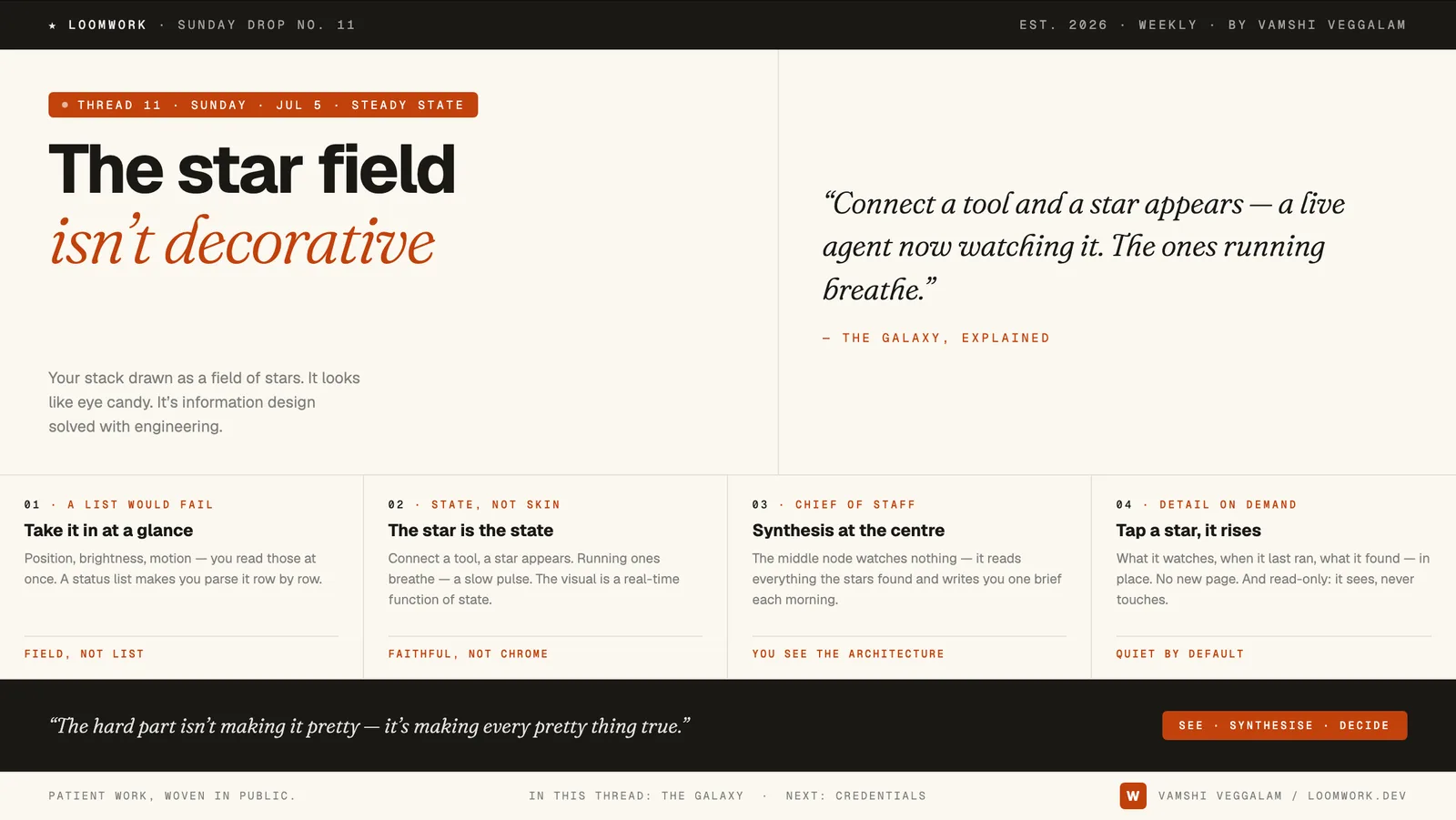
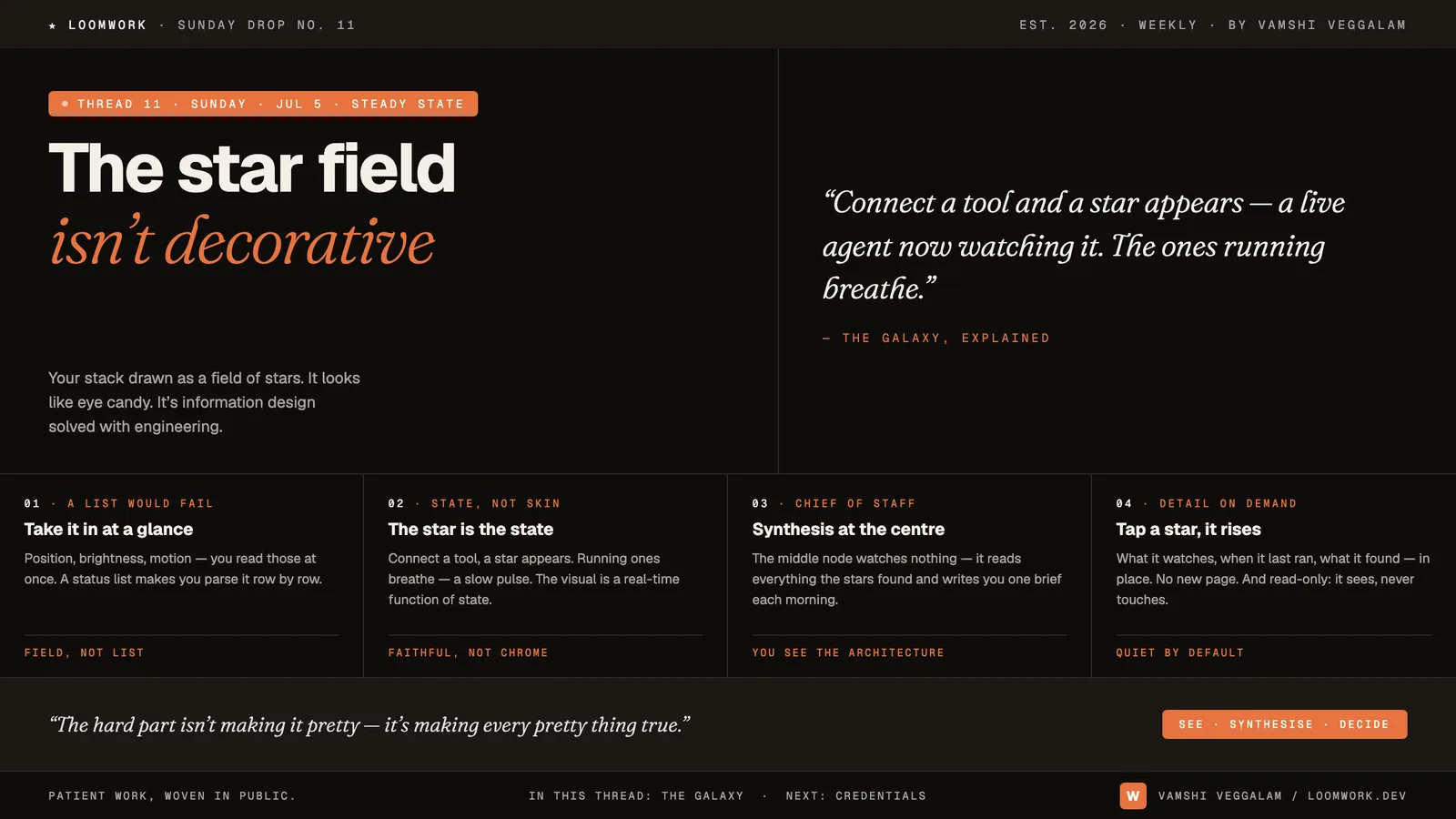
The first thing people say about Foundry's Galaxy is that it's pretty. Your stack, drawn as a field of stars, a chief of staff glowing at the centre. The second thing they assume is that it's decoration — a nicer skin over what could be a list.
It isn't a skin. The star field is the interface, and the visual is carrying information a list would have buried.
A list would have failed
The obvious way to show "here are your agents and how they're doing" is a list with status badges — green dot, red dot, last-run time. It works for five rows. It stops working the moment you have a real operation. A list makes you read to understand: you scan row by row, parsing badges. At-a-glance comprehension is the one thing it can't give you.
A field can. Position, brightness, motion — you take those in at once, before you've read a word.
The star is a function of state
Each star is wired directly to what its agent is doing. Connect a tool and a star appears — that's your agent, now watching that one tool. The ones actively running breathe: a slow pulse on the halo, so "this is alive and working" reads without a label. When one fails, it's built to dim and flag itself the same way — though I'll be honest, with a 100% run rate so far, I haven't had to watch that happen yet.
The point isn't the animation. It's that the visual is a faithful, real-time function of the underlying state — not a decoration applied on top of it.
The chief of staff at the centre
The middle of the field isn't empty space. It's the chief of staff — the one node that watches nothing itself and reads everything the stars found. The layout says what the system does: specialists on the outside, synthesis at the centre, one brief out the top each morning. You understand the architecture by looking at it.
Detail without clutter
A canvas can drown you in labels, so this one stays quiet — names, orbits, the centre — and detail rises only when you ask. Tap a star and its popover lifts in place: what it watches, when it last ran, what it found. No new page. No lost context. You drop back to the field and keep your bearings.
And it can't touch anything
Every star is read-only by design. An agent can see your GitHub or your Vercel; it cannot change them. That constraint is the first thing I'd want to know before handing anything access to my own stack — so it's the first thing the interface makes true.
The visual carries the model
None of this is ornament. The centre means something, the orbits mean something, the pulse means something. The whole point is that you understand your operation by looking, and reach for words only when you choose to.
The hard part of an interface like this isn't making it pretty. It's making every pretty thing true — a faithful function of the system underneath.
Next: how I handle the credentials those agents run on — and what I deliberately haven't built yet.
— Vamshi
Loomwork is by Vamshi Krishna Veggalam. Building Foundry at mindloomhq.com, with the full archive at loomwork.dev. Find me on LinkedIn.
This thread first ran on LinkedIn on July 5, 2026 — the conversation is over there. Read it on LinkedIn and join the thread